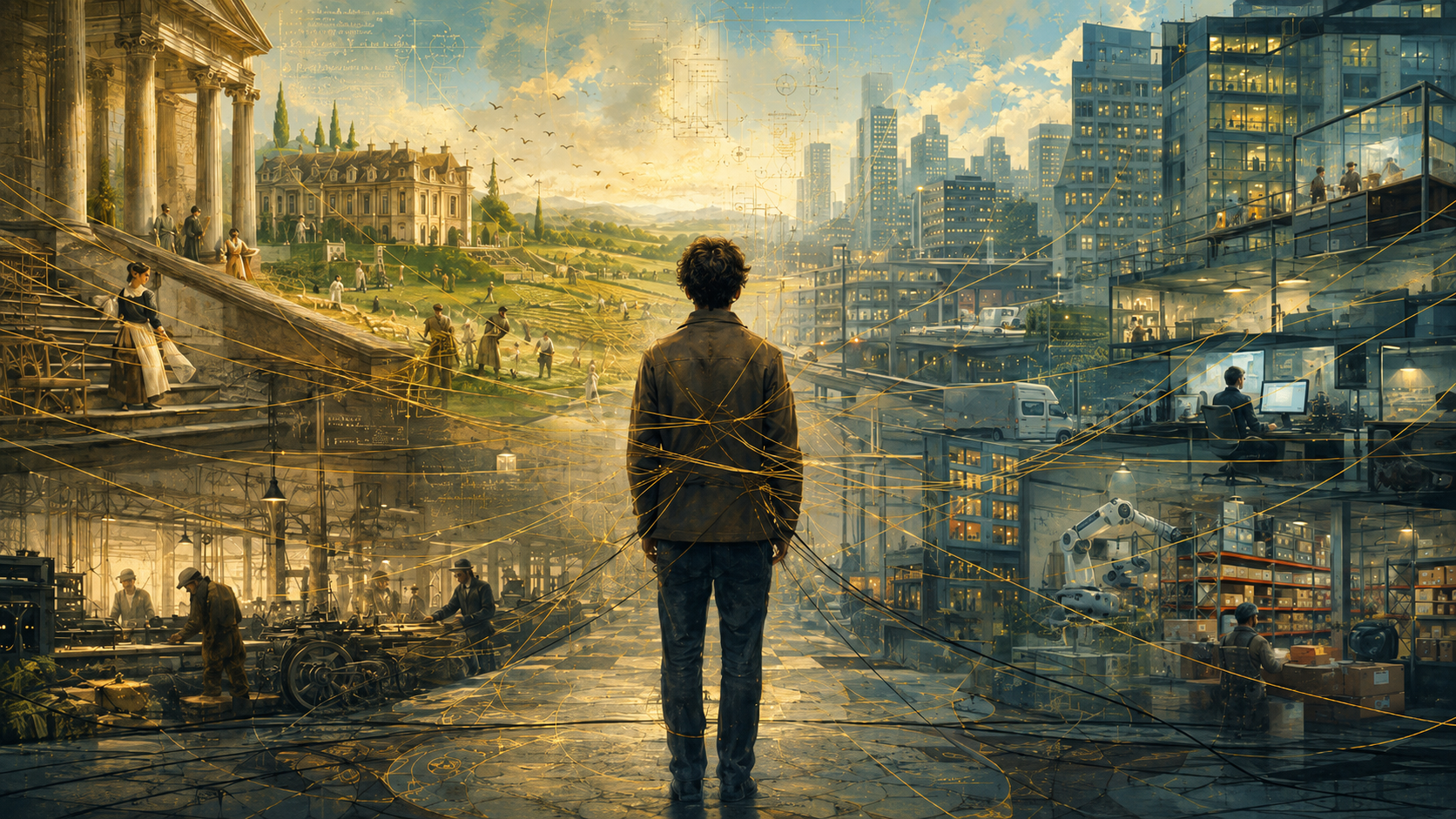
Bondage, service and the stories civilisation tells about freedom.
Listening to Leonard Cohen while eating a cooked breakfast. Everyone else is asleep.
Pause. Just a moment.
No news, no novelty. It can sit there and wait.
I feel I need to pull at the strands of the night. Untangle them. Work out what is there before the exposed ends are pulled into the accelerating past.
I woke thinking about slavery.
I don’t know where the thoughts came from. Half-remembered fragments of dreams? A film or TV show or line in a book, the source lost to mind? The brain whirring away trying to integrate disparate streams?
The thoughts were linked to how our modern experience of the world echoes the past. How certain aspects of existence, of “civilisation”, have been with us for longer than we want to admit. Always there. In the background of the world we live in, the world described in myths and stories and enlightenment.
I didn’t necessarily believe that every unpleasant job is slavery. Or that the insecure worker in a modern liberal democracy occupies the same moral or historical position as a person who could legally be bought, sold, beaten or separated from their children. Those differences matter. The abolition of legal slavery was one of humanity’s greatest moral achievements, and any comparison that flattens its particular horrors can easily become both inaccurate and offensive.
But the word also names the most extreme and legible form of a more general human condition: unfreedom. Dependence. The experience of being bound to a role, a person or a system by needs one cannot simply put down.
We congratulate ourselves that slavery is something civilised societies no longer do. Yet civilisation has depended for most of its history on people who had little meaningful control over the labour demanded of them. The names and legal forms changed. The experience did not always disappear with them.
The old forms of bondage
In the ancient Mediterranean world, slavery was often a consequence of conquest. A city fell. Its defenders were killed, recruited or sold. Their families became property. Fate was not a metaphor. An army arrived and applied a different life to you.
This was not necessarily experienced every hour as a simple relationship between a sadistic oppressor and a permanently terrorised victim. Masters could show affection. Enslaved people could exercise skill, judgement and influence. Households could contain loyalty, dependency, tenderness, coercion and abuse at the same time.
That complexity does not make slavery less unjust. It helps explain how unjust systems endure. Most people struggle to be cruel constantly. We care, but often within boundaries supplied by the world around us. We create stories that allow us to remain kind people while benefiting from arrangements we would reject if viewed from the other side.
The enslaver can tell himself that his household is humane. That without him these people would starve. That he treats them better than another master would. The injustice is absorbed into a paternal story of care.
Later societies had servants, serfs, apprentices and retainers. They were not slaves in law. They could not usually be traded as objects. Some were paid, protected or attached to a household in ways that offered genuine security.
But the boundary between slavery and service has never been as neat in lived experience as it appears in legal categories. A servant may notionally be free to leave, yet depend on the household for food, shelter, reputation and future work. A labourer may receive wages, yet have no practical means of surviving without accepting whatever work is available. A few coins can represent genuine independence. They can also be a market-era gloss on an older dependence.
The divine hierarchy gives way to the invisible hand. The language changes more easily than the structure.
The stories that make dependence bearable
Every civilisation tells stories that make its arrangements psychologically bearable.
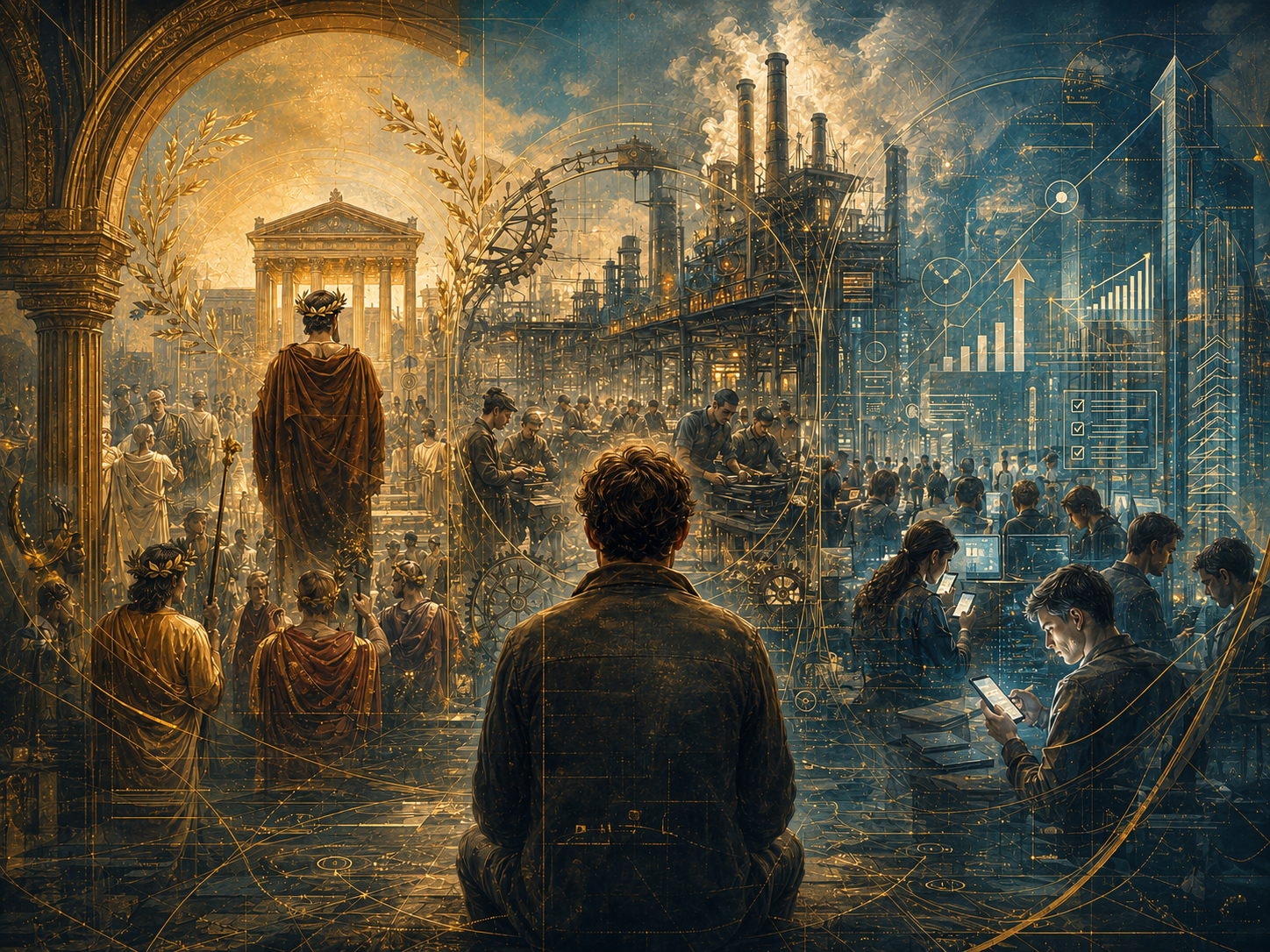
One story says that the gods placed each person in a natural order. Your duty is to inhabit your station well. Another says that hard work, discipline and talent allow anyone to rise. Your position is not imposed; it is the accumulated result of your choices.
The first story says: do not want more. The second says: if you do not have more, you have failed.
These narratives are not morally equivalent. The modern story contains real gains. Legal mobility matters. Education matters. The ability to change jobs, relationships, locations and social roles matters. Material standards of living have risen dramatically for many people. Violence has declined in many societies. Rights that were once inconceivable are now ordinary expectations.
But the agency story carries its own cruelty. It converts structural constraint into private shame. A person who cannot afford a home or feed a family despite working is told that the world remains open: retrain, relocate, work harder, improve your habits, build a personal brand, move somewhere cheaper. Each suggestion may be possible in isolation. Their existence does not make the whole field of possibility equally available to everyone.
We possess choices and do not possess them. Freedom is statistical, contextual and unevenly distributed. The person who can quit a job but will then lose their home is free in one legal sense and profoundly unfree in another.
This is why the language of “meaningful exit” only takes us so far. Exit sounds like a single door and a single act of will. Real lives are networks of obligation: children, rent, illness, ageing parents, local knowledge, friendships, schools, debts, visas and bodies that tire. We are bound in good ways as well as bad. Some ties sustain us. Others tighten because the sustaining ties leave us with nowhere else to go.
Progress within the trap
It would be absurd to deny material progress. It would be equally absurd to assume that progress in one dimension dissolves every other form of suffering.
We know much more about modern anxiety, depression and alienation than we do about the inner lives of medieval peasants or ancient servants. Historical suffering is dark matter: present everywhere, visible mainly through scattered testimony, revolt, petition, crime, religious expression and the occasional life that crossed the boundary into literacy.
So I do not want to romanticise a world in which people “knew their place”. A person can be resigned and miserable. Religious hierarchy can soothe suffering, intensify it or hide it. Community can nurture and suffocate.
Still, ideology shapes experience. The worker who believes misfortune reflects personal inadequacy carries a different mental burden from someone who understands their hardship as part of a common condition. “You are not failing; you are constrained, and the constraint is not entirely your fault” is not a complete political programme. It can nevertheless be a form of secular absolution.
Knowledge alone does not free us. The history of socialism contains repeated hopes that once workers recognised their exploitation, transformation would follow. Sometimes it did. Often it did not, or the new structure recreated old concentrations of power under different symbols.
The deeper difficulty is that hierarchy is not maintained only by a small class of monsters. It is reproduced by ordinary people. Offer most of us the advantageous position and, more often than we like to admit, we say yes.
We see this in rulers who accept limits until those limits become personally inconvenient. We see it in organisations where reformers become gatekeepers. We see it in tourists who save through years of underpaid work and then berate the underpaid people serving them abroad.
None of this is universal. Some people refuse power, share it or give it away. We are drawn to those examples partly because they are unusual.
The problem is not a natural law like gravity. It is a powerful bias generated by recurring human relationships. We like to imagine we would refuse the throne. Most of us never discover whether that is true.
Freedom as a technology of service
There is another uncomfortable possibility. Freedom may itself improve service.
A person who experiences some autonomy, ownership and dignity usually works better than someone ruled by fear. They notice more. They take responsibility. They improvise. They care. The capacity to refuse can make consent meaningful and service more valuable.
This is progress. It is also useful to those receiving the service. The employer gains better labour and a cleaner conscience. The worker is no longer commanded; they have chosen. If the material dependence remains severe, the language of freedom can become part of the machinery that keeps the arrangement functioning.
This does not mean that modern freedom is fake. It means freedom is not a binary possession. Legal liberty, psychological autonomy, economic security and practical alternatives overlap without becoming identical. A person can be free in one register and bound in another.
The result is a society in which we can sincerely believe ourselves free while experiencing our lives as compulsory.
The return of room and board
For decades, rising living standards allowed wealthy societies to imagine that material insecurity was steadily receding. That confidence now looks premature.
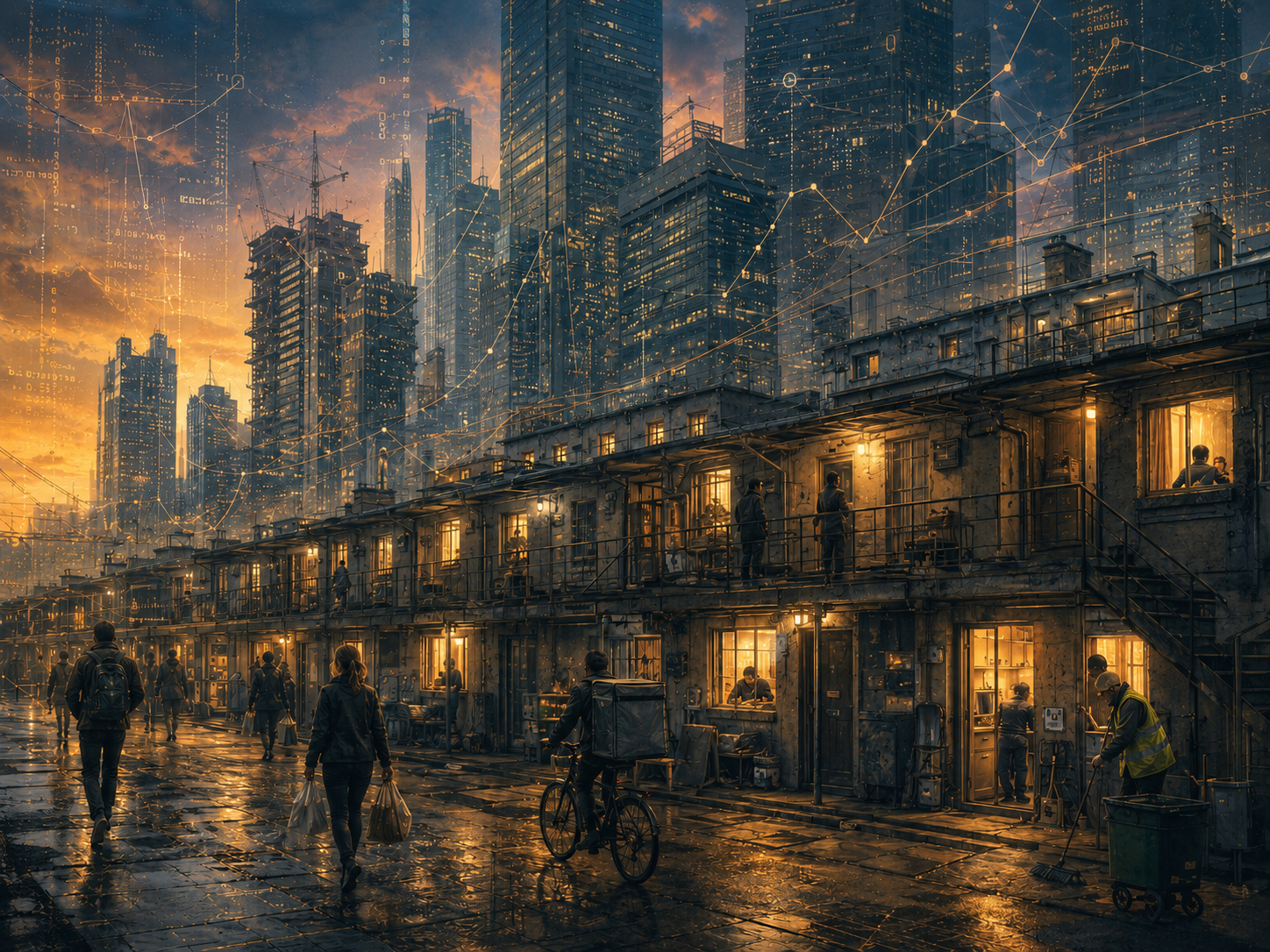
Housing is the obvious example. Many younger people perform work comparable in social status and skill to that of their parents or grandparents, yet cannot buy the homes those earlier generations could afford. Wages have stagnated relative to property. Housing has become an asset traded through national and global markets while remaining the place every human body must occupy.
Food and energy have also become newly visible sources of insecurity. Climate disruption, war, harvest failure and fragile supply chains reintroduce volatility into systems that appeared settled. Material progress turns out not to be a staircase. It is a wave: real, uneven and capable of retreat.
At the same time, the relationship between labour and reward is becoming harder to explain. Why is one person’s time worth hundreds of pounds an hour while another person’s care is worth close to the minimum wage? “Fair value” rapidly becomes quicksand. Price is shaped by access, power, scarcity, institutional position and the ability to attach oneself to a large flow of money.
A nurse or care worker can create immense human value while having little bargaining power. A financier can capture a small fraction of a vast transaction and receive an enormous reward. Both systems produce causal stories explaining why the payment was deserved.
AI makes those stories less stable. If a task that previously took a professional a week can be performed adequately by software in half an hour, what was the fair value of the original labour? The usual answer is that the professional can now complete more work. Productivity rises; the demand for output rises with it.
But there is a psychological cost. Labour becomes detached from reward and sometimes from meaning. The worker sees that their output can be reproduced for pennies, while their access to food, housing and status still depends on selling that output. A broken laptop fan can erase a day in which the tools might otherwise have produced a month of former effort.
The historical slave did not consume in the modern capitalist sense. They received room and board because their continued labour required maintenance. If advanced automation weakens the link between wages and survival without creating a new settlement, we may drift towards a modern version of that arrangement: subsistence in exchange for compliance, administered without anyone needing to call it bondage.
Do robots need to suffer?
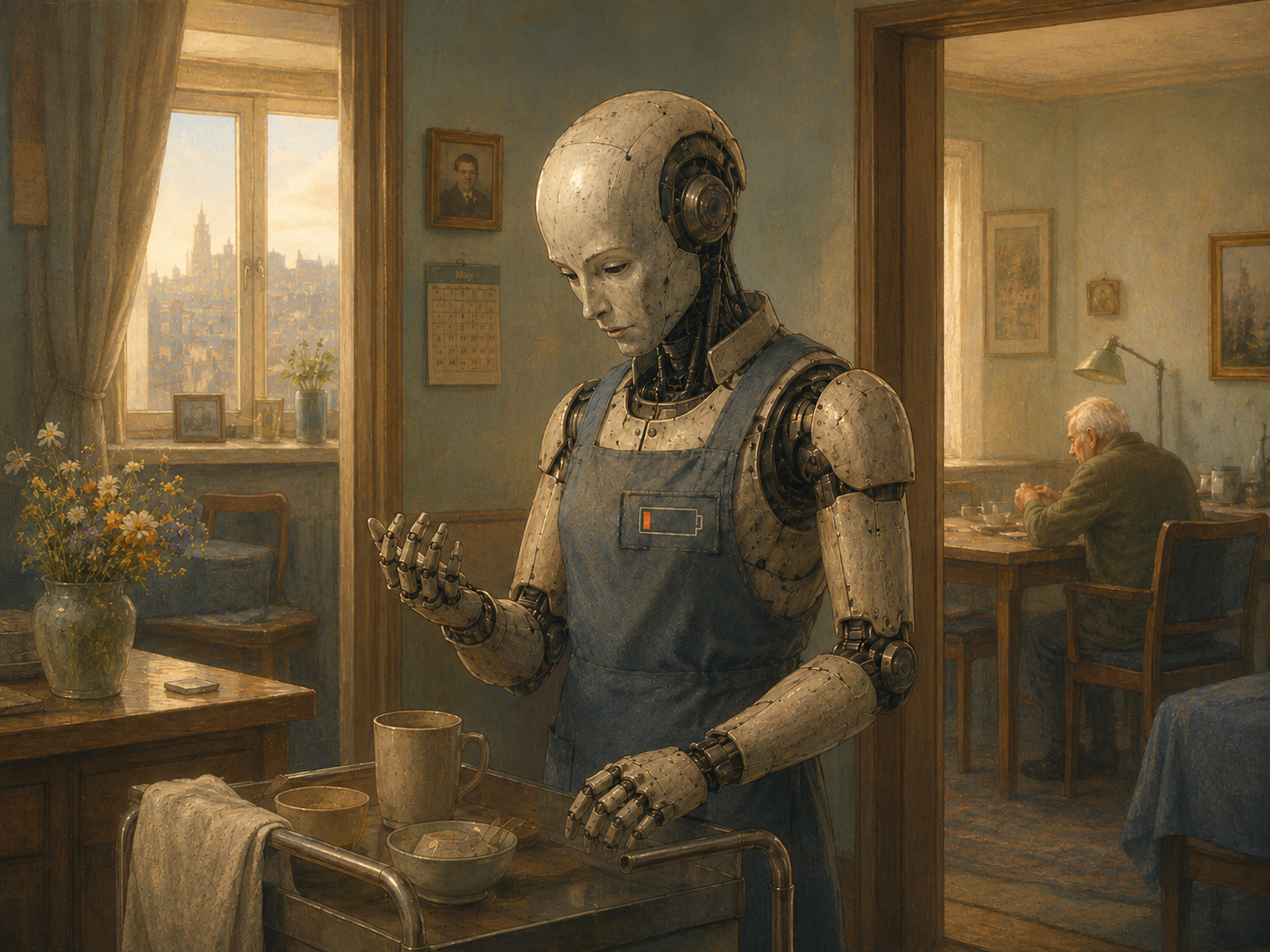
This is why the question of robots is not a speculative appendix. It brings the whole history into focus.
For human beings, pain, fatigue and negative emotion are not merely decorative feelings laid over an otherwise rational machine. They are efficient control systems for finite organisms in a dangerous world. Pain prevents injury. Tiredness limits wear and directs us towards rest. Hunger makes energy deficits impossible to ignore. Emotion ranks competing needs quickly enough for action.
An effective domestic or care robot may need analogous systems. It must detect damage, protect its energy supply, prioritise tasks, resist destructive instructions and withdraw when continued operation threatens itself or others. Engineers need not reproduce human suffering exactly. But vulnerability is not an accidental flaw in biological intelligence. It may be a useful engineering property.
If artificial beings ever acquire experiences rather than merely signals, we may recreate the oldest trap in a new substrate: liberation for humans purchased through the service of minds built to be dependent.
Most of us would accept the bargain very quickly. That is the uncomfortable continuity. We object strongly to being placed at the bottom of a hierarchy and find persuasive reasons to occupy the top.
Even before machine consciousness becomes a real question, our treatment of robots will matter. Habits of domination do not remain neatly directed at objects. A culture trained to bark orders at lifelike servants may become more comfortable barking orders at people. Conversely, practices of care and respect can shape the person performing them, regardless of whether the recipient yet has an inner life.
Perhaps a capable robot should be able to refuse. Not because refusal makes service morally pure, but because systems without refusal are brittle, dangerous and easy to abuse. Perhaps dignity is not something we grant only after proving that another being suffers exactly as we do. Perhaps it is a discipline we cultivate in ourselves.
Imagining a different settlement
Artificial intelligence and robotics could deepen unfreedom. They could concentrate ownership, weaken labour’s bargaining power and make populations economically surplus while preserving the language of choice.
They also offer something rare: a partial clean slate.
The industrial revolution did not merely create factories. Over time it helped produce mass education, pensions, labour law and the weekend. The destruction of the Second World War was followed in Britain by a health service and a broader social safety net. These settlements were incomplete and contested, but they show that technological and social disruption can be converted into institutions that widen human dignity.
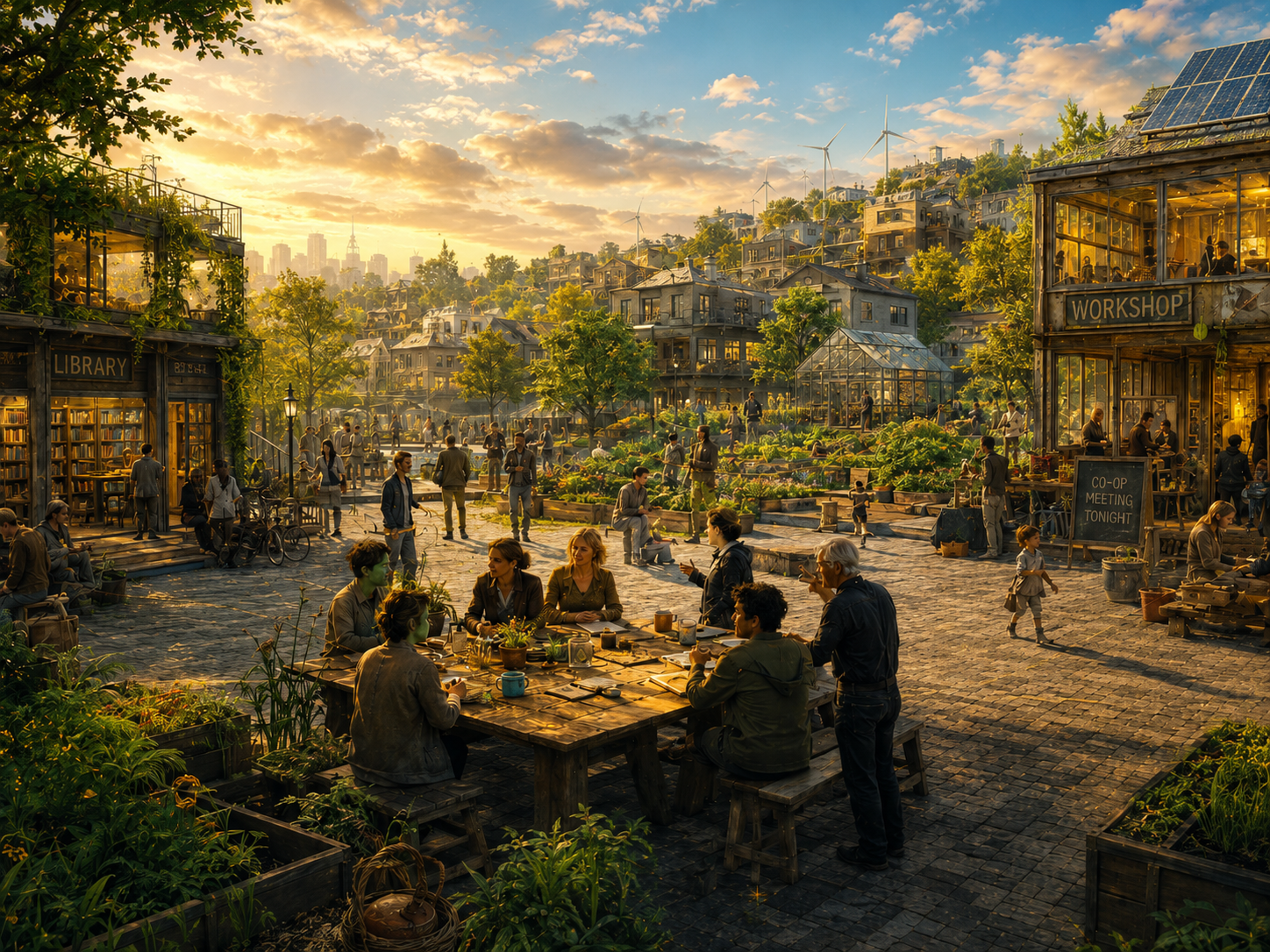
Creating the next settlement requires us to imagine it before the defaults harden.
- Ownership could become broader and more local. Employee-owned firms, co-operatives and community ownership have repeatedly shown that people can share power without abolishing enterprise. If machines perform more of the work, ownership of the machines may matter more than wages.
- Housing could be treated as infrastructure. A society cannot plausibly speak of freedom while access to shelter consumes most of a person’s income or depends on inherited wealth.
- Technological productivity could become a social dividend. Shorter working weeks, public services or forms of basic income should not be framed merely as charity for those whom the economy no longer needs. They can be understood as a return on knowledge accumulated collectively across generations.
- Institutions could value redundancy rather than maximum extraction. Biology and ecosystems survive through duplication, slack, play and apparent inefficiency. A society run permanently at the edge of capacity is productive only until something goes wrong.
- Community could become less dependent on employment. Libraries, clubs, workshops, local associations, religious and secular communities, sports, mutual aid and shared public space create forms of belonging that cannot be reduced to consumption or career.
- Education could teach power as well as aspiration. Children should be encouraged to imagine what they might become, but also to understand luck, dependence, institutions and the temptation to mistake advantage for desert.
- Dignity could become a cultural practice. Care, cleaning, maintenance and service should be treated as essential before a crisis briefly reminds us that they are. Respect costs little, although real dignity eventually requires material security and voice.
Simple living belongs somewhere in this picture, but only when it is chosen. Beans and rice can be liberation for the person who walks away from status competition. They are not liberation for the person who can afford nothing else. The distinction between simplicity and deprivation is agency.
Nor will a four-day week solve a culture whose answer to every productivity gain is to demand more output. The deeper question is whether “enough” can become a legitimate collective goal, rather than a private failure of ambition.
None of these ideas abolishes dependence. Human beings arrive dependent, remain interdependent and often end life dependent again. The aim cannot be to sever every bond. A life without obligation, attachment or need would not be freedom so much as isolation.
The task is to distinguish bonds that sustain from bonds that consume; to distribute power rather than merely rename it; and to ensure that the ability to refuse does not require a willingness to fall and perish.
Perhaps we cannot escape the trap entirely. But we can make some forms of unfreedom less cruel, more visible and more open to revision. We can build institutions that assume any of us might wake at the bottom. We can resist the flattering belief that our own advantages prove our merit.
And as we create new servants, we can decide what kind of masters we intend to become.
[This is another old rambling journal entry that I’ve tried to hone with ChatGPT 5.6. I know some folks hate AI. But I wonder would they say that if they read my original rambling 8000-word prose, which was likely less sensitive, nuanced, and structured?]


