A quick guide to a practical "vibe-coding" setup that can get you up-and-going within minutes.
Vibe-Coding – A Practical Guide

Thoughts from My Head
A quick guide to a practical "vibe-coding" setup that can get you up-and-going within minutes.
Introduction In my spare time I'm trying to make some progress on a coding project called TherapyBot. Despite its name, it's not strictly about therapy - that's just one potential use case. The main aim? To test out some ideas and, let's be honest, to level up my coding skills. What's TherapyBot, anyway? At its … Continue reading TherapyBot: Exploring Knowledge Graphs and LLMs in Chat-Based Applications

The post shares their journey of setting up a cost-effective CI/CD pipeline for AI applications using GitHub Actions and Docker. Emphasizing branching, versioning, and meticulous testing, the post highlights the importance of simplicity, efficiency, and automation in achieving a streamlined development workflow.
This post outlines a process for handling GitHub issues, including determining the type of issue, identifying relevant code, and resolving the issue through testing, correction, and pull requests. It also discusses the potential for automation using LLMs and user templates, as well as the use of vector search in repositories.
Some notes from my project to create self-coding software. The post emphasises the power of testing, "good code" practices, pain points, and cool features we can leverage. These include GitHub/IDE code review GUIs, tools like Ruff and Sphinx, and Test Driven Development, modularity, code duplication, and profiling.
The author is developing a self-coding project using Large Language Models (LLMs), such as GPT3.5/4-turbo and GPT4, to generate code, tests, and documentation. Existing project files are used as LLM prompt context. Evaluation tools from the Python ecosystem, GitHub API and function calling options are leveraged to streamline the process. The system has been designed to cater for various programming tasks. However, tweaking different agent "personalities" and effectively managing complex project directories remain challenges.
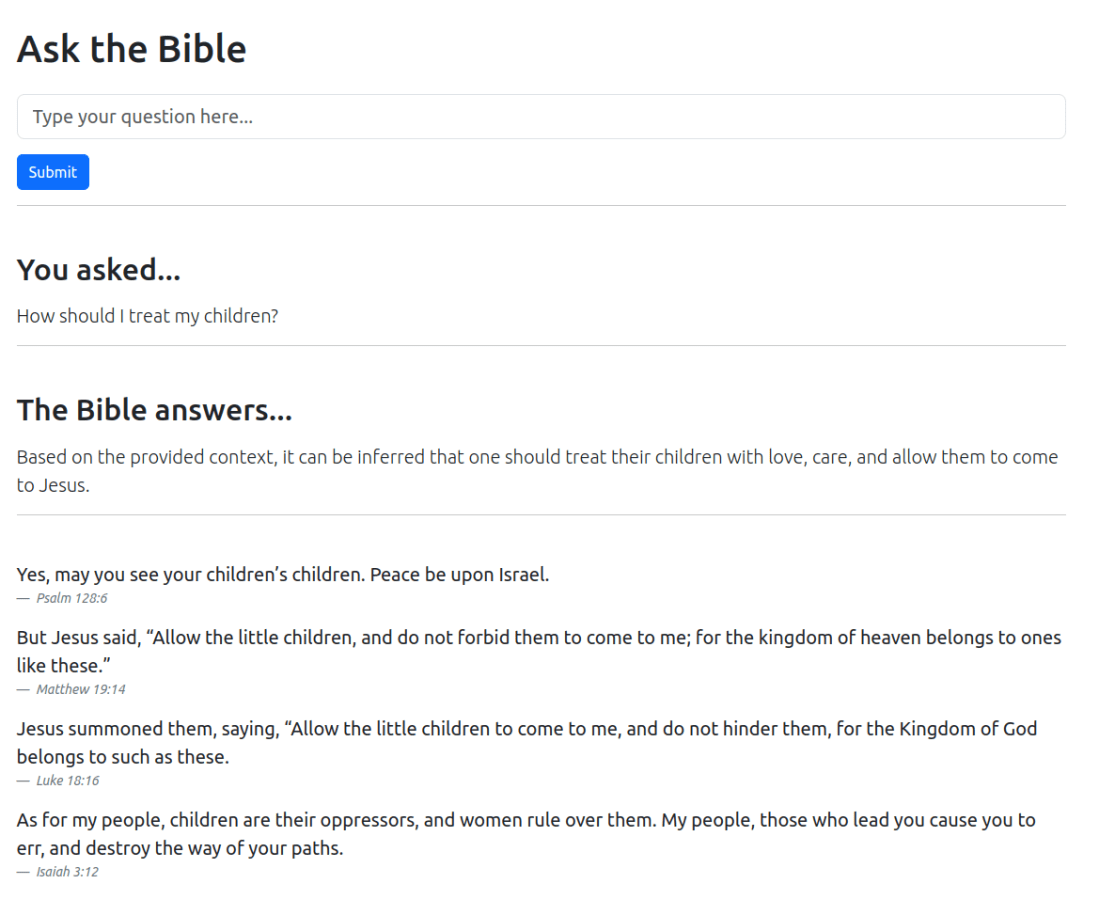
If I had lived in the C14, I would have liked to be a monk. This post channels my inner monk to explain how you can build a proof-of-concept exegesis system on the Bible and Quran with langchain.
[Spoiler - I got ChatGPT to write this blog post based on an auto-generated Readme file summary of an auto-generated code repository. This is what the future of coding will look like. More nested generations than a Christopher Nolan movie.] Software development is a complex and time-consuming process. With the advent of Artificial Intelligence, automating … Continue reading Coding Agent: Automating Software Development with LLM
Most of my projects these days involve building a web API. Building a web API using REST principles allows you to bolt on multiple different front-ends (e.g., React app or iOS/Android app) and easily access functions from other computers. But building the infrastructure of the API often takes time, time I'd really like to spend … Continue reading Speeding Up API Development
Introduction When working with FastAPI and SQLAlchemy, you may encounter an issue where your tables are not created in the database even though your code seems to be correctly set up. A common reason for this is having multiple instances of declarative_base instead of a single shared instance. In this blog post, we'll walk you … Continue reading Organising SQLAlchemy Base and Models in FastAPI Projects
 Robotic Ape